The United States is the world’s largest economy — $30.49 trillion in Q2 2025 (BEA). Services account for 82.8% of value-added, the highest share among major economies, driven by finance, healthcare, and technology. Industry contributes 16.4% — a share that has contracted from over 35% in the 1950s as manufacturing shifted and the service economy expanded.
GDP by sector — which industries produce the value
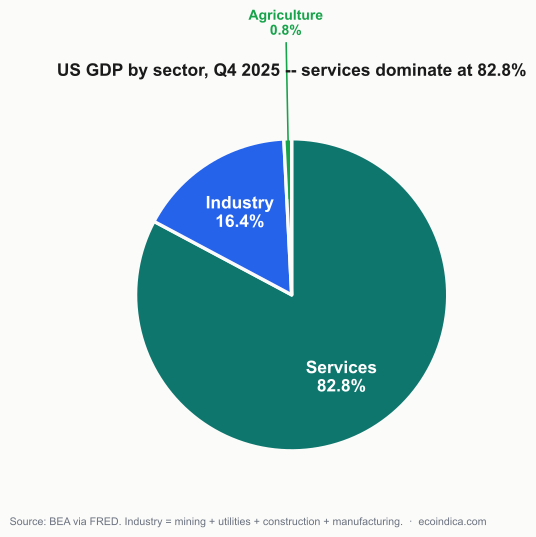
Source: BEA via FRED (VAPGDPAFH, VAPGDPM, VAPGDPU, VAPGDPC, VAPGDPMA), Q4 2025. Value-added as % of GDP, current prices.
| Sector | Share of GDP | What it includes |
|---|---|---|
| Services | 82.8% | Finance, healthcare, retail, professional services, information technology, education |
| Industry | 16.4% | Manufacturing, construction, mining, utilities |
| Agriculture | 0.8% | Farming, livestock, fishing, forestry |
| Total | 100% |
What the numbers say
The US is one of the most service-intensive large economies on earth. At 82.8%, the services share is well above the OECD average — a gap that has widened continuously since the 1970s. Finance, healthcare, business services, retail, and information technology account for the bulk of that share; manufacturing and construction together contribute about 13 of the 16.4% industry slice.
Agriculture’s 0.8% share is not a sign of weakness. It reflects a highly productive farm sector that supports both domestic food supply and significant export trade with a tiny fraction of the workforce; the US is among the world’s largest agricultural exporters by value (FAO).
The long-run trend is unambiguous: industry peaked at over 35% of US GDP in the mid-1950s and has contracted in almost every decade since. Services absorbed the difference. This structural shift — sometimes called deindustrialisation — characterises most high-income economies; the US moved further and faster than most.
Data note: BEA GDP by Industry via FRED, Q4 2025. Value-added as % of GDP at current prices. Industry = mining (NAICS 21) + utilities (22) + construction (23) + manufacturing (31–33). Services derived as residual.
GDP by expenditure — who spends it
The sector chart above and the expenditure table below measure different things. Sector = which industries produce the value; expenditure = who spends it. Both are correct; they answer different questions.

Source: BEA NIPA Table 1.1.5, Q2 2025. Shows how total spending is allocated, not which industries produce the output.
| Component | Amount (Billions $) | Percent | Pie Chart Percent |
|---|---|---|---|
| Consumption | 20,789.9 | 68.20% | 53.55% |
| Investment | 5,358.6 | 17.58% | 13.80% |
| Government | 5,237.0 | 17.18% | 13.49% |
| Exports | 3,267.5 | 10.72% | 8.42% |
| Imports | 4,167.3 | -13.67% | 10.73% |
| Total GDP | 30,485.7 | 100.00% | 100.00% |
Source: BEA NIPA Table 1.1.5, third estimate. SAAR in billions of current dollars. Q2 2025.
Sources & notes
- Sector data (Q4 2025): Bureau of Economic Analysis, GDP by Industry via FRED — series VAPGDPAFH, VAPGDPM, VAPGDPU, VAPGDPC, VAPGDPMA. Value-added as % of GDP, current prices. Accessed 2026-06-19. BEA revises these estimates each July; figures will be updated when July 2026 data is released.
- Expenditure data (Q2 2025): BEA National Income and Product Accounts (NIPA) Table 1.1.5, third estimate. SAAR in billions of current dollars. Accessed 2025-10-26.