China’s economy reached ¥134.9 trillion (~$18.75T) in 2024, the second-largest in the world. Services now account for 56.7% of value-added — overtaking industry for the first time around 2013 and widening the gap since. Industry remains the second-largest sector at 36.5%, more than double the share seen in most developed economies, reflecting China’s continued role as the world’s dominant manufacturer.
GDP by sector — which industries produce the value
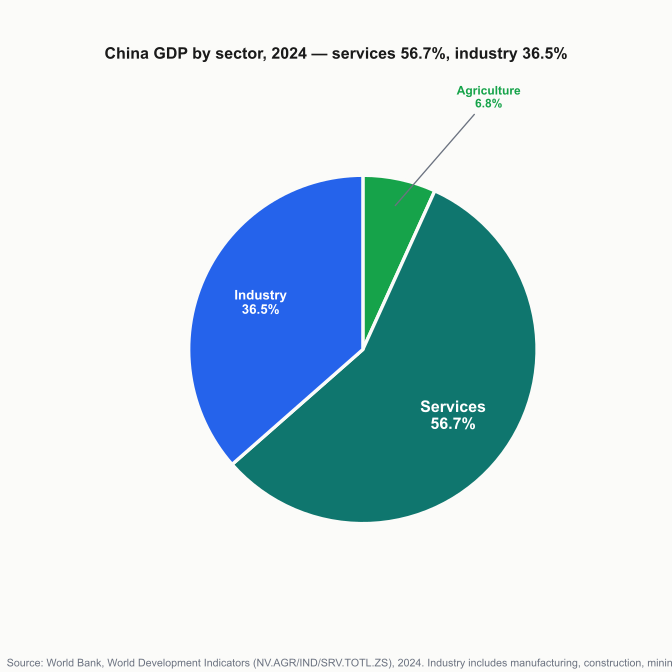
Source: World Bank WDI (NV.AGR/IND/SRV.TOTL.ZS), 2024. Value-added as % of GDP, current prices.
| Sector | Share of GDP | What it includes |
|---|---|---|
| Services | 56.7% | Wholesale/retail, finance, real estate, transport, public administration, education, health |
| Industry | 36.5% | Manufacturing, construction, mining, utilities |
| Agriculture | 6.8% | Farming, forestry, fishing |
| Total | 100% |
What the numbers say
China’s industry share (36.5%) is roughly double that of the US (17%) or UK (17%), reflecting four decades of export-led industrialisation and the world’s largest manufacturing base. But the structural shift is real: services have grown from 41% in 2000 to 56.7% in 2024, driven by the rise of domestic consumption, e-commerce, finance, and property. Agriculture at 6.8% remains higher than any G7 economy — China still employs roughly a quarter of its workforce in farming, even as the sector’s GDP share shrinks. The speed of China’s sectoral transition (agriculture → industry → services) mirrors the path of today’s rich economies, compressed into three decades.
Data note: World Bank NV.* series, 2024; cross-checked against NBS China 2025 data (within 1pp). Some older CIA World Factbook-derived tables show a higher industry share (~40%); those reflect different vintage NBS revisions. The World Bank figure (36.5%) is consistent with current NBS reporting.
GDP by expenditure — who spends it
The sector chart above and the expenditure table below measure different things. Sector = which industries produce the value; expenditure = who spends it. Both are correct; they answer different questions.

Figure 2: China GDP Composition by Expenditure (C+I+G+NX), 2024
| Component | Amount (CNY) | Amount (USD) | % of GDP |
|---|---|---|---|
| Consumption | ¥53.86T | $7.48T | 39.9% |
| Investment | ¥54.79T | $7.61T | 40.6% |
| Government | ¥22.44T | $3.12T | 16.6% |
| Exports | ¥27.02T | $3.75T | 20.0% |
| Imports | −¥23.17T | −$3.22T | −17.2% |
| Total GDP | ¥134.93T | $18.75T | 100% |
Source: National Bureau of Statistics of China / World Bank WDI, 2024. Nominal, current prices.
Sources & notes
- Sector data (2024): World Bank, World Development Indicators — NV.AGR.TOTL.ZS, NV.IND.TOTL.ZS, NV.SRV.TOTL.ZS. Value-added as % of GDP, current prices. Accessed 2026-06-21.
- Expenditure data (2024): NBS China / World Bank WDI. Nominal, CNY and USD.
- Cross-check: NBS China 2025 reports agriculture 6.7%, industry 35.6%, services 57.7% — within 1pp of World Bank figures. ✓